
Archive
Tipo contenuto: Article
Article
Open Access
An Eco-Leap Forward: Shifting Agriculture
by Xinyu Xiao, Hai Anh Nguyen
pp. 563–583
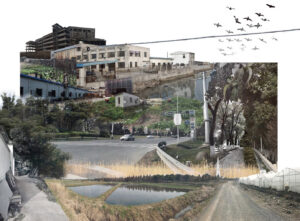
Human activity has been changing the surface of the earth for several thousand years. In recent decades, the rate of change however was accelerated in the Yangtze River Delta, propelled by China’s rapid and continually chaotic process of urbanization and industrialization. How can our cities eventually face haze, water pollution, soil contamination, and natural disasters caused by climate change? The challenge is indeed to explore how to achieve an ecological resilience by enhancing biodiversity and by reviving and revising productive landscape.
Article
Open Access
Fragile Edges and Floating Strategies along the Albanian Coastline
by Loris Rossi, Laura Pedata, Enrico Porfido, Giuseppe Resta
pp. 685–705
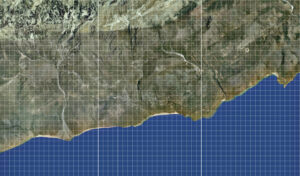
The essay investigates coastline development along the southern area of the Albanian Riviera, introducing the concepts of “landscape fragments” and “landscape within a landscape” as design methodologies. By speculatively reversing the order of landscape perception from land to water, the coastline becomes a flexible device capable of responding to unpredictable future events - natural disasters related to climate change (rising sea levels), or globally challenging socio-political phenomena (such as mass migration growing in scope, complexity and impact). The experimental design approach involves the design and representation of an incremental waterscape. By reversing the morphological perception of the coastal landscape and making a set of tactical selections in natural and artificial landscapes, the students highlighted the territory’s potential. With new awareness, they proposed site-specific interventions along the coast and inland, re-territorializing the “apparent tabula rasa” and demonstrating the coastline’s potential dynamic reaction to environmental challenges.
Article
Open Access
Salinas: Interstices of the Urban, Cultural and Political Processes in Mediterranean Ecologies
by Ana Morcillo Pallares
pp. 707–719
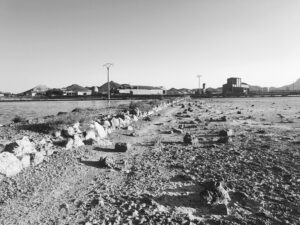
Salinas, or Mediterranean coastal salt marshes, are priceless ecological wetlands, resilient spaces along the coast that have survived over time and hold incalculable cultural, historical, and ethnographic values associated with them. Today, artisanal sea salt production is no longer a profitable business, and in many cases, these spaces become a no-man’s-land in-between nature and city, falling victims to pressures of changing land uses and the unsustainable urban growth of the Mediterranean coastal tourism. However, the process of change and abandonment of these former production landscapes presents an opportunity to promote new formulas for spatial tactics, public use and new sustainable futures. A liminal condition full of spatial and formal assets that opens the rising potential of the local economy and the right of the salina’s active exploitation, interaction and identification.
Article
Open Access
Between Land and Sea: Reshaping the Belgian Coastline A Case Study between Ostend and Blankenberge
by Wim Wambecq, Bruno De Meulder
pp. 721–741
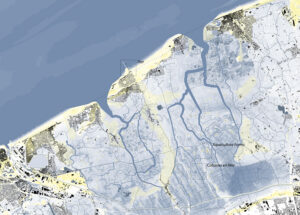
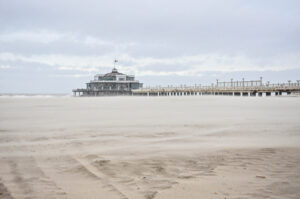
Over time, the Belgian coast has developed into a hard-engineered straight defence line - from the sea inwards - of flat beaches, dykes and a storm wall that is reaching its capacity limits. New plans are being developed in some parts of the coast aiming to raise the storm walls up to “acceptable” levels, based on climate change and sea level rise predictions. This follows the trends of raising river protection walls, but continuously insists on the linear urban structure of the coastline: beaches, dyke, urbanization wall on the dunes and housing proliferation into the back polders. These are often low-quality holiday houses built for the summer season rush. This essay investigates an alternative future for the Belgian coast through research-by-design. The design exploration proposes to seize the opportunity of the increased peril, predicted from climate change and subsequent sea level rise. Furthermore, it proposes a shift from hard to soft engineering and a dynamic tidal landscape within which the tourism economy is reinvented.
Article
Open Access
Waterscapes in Transformation: The Case of the Belgian Coastal Area
by Sis Pillen, Kris Scheerlinck, Erik Van Daele
pp. 743–766
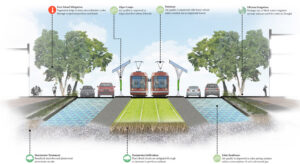
The socio-economic impact of nature in Belgian coastal landscapes on a regional scale is high due to their general attractiveness for visitors, their strongly developed tertiary service economy and other related sectors (tourism, residential, agriculture…). Due to climate changes however, these coastal landscapes and their required accessibility and continuous character are threatened by the unavoidable planned infrastructures (dikes, new connections, floodable areas, etc.) that will generate ruptures, frictions and additional transition spaces within the landscape. Flanders urgently needs to unfold policies and strategies to avoid or reduce the undesirable effects of the expected changes. Influential changes for the coastal zone will be sea level rising, increasing temperature, changing rainfall patterns, floods, fragmented ecological system, salinization, and reduced drainage capabilities to sea. A thoughtful planning policy forms the necessary key to a sustainable development. Policies and plans lead to the formulation of spatial proposals for mitigation and adaptation, to be executed by major infrastructural works planned for the next decades. Most of these infrastructures, conceived at a large scale, generate a different model of accessibility for the Flemish Coastal landscape.
Article
Open Access
(Geo)Design Coastal Cities: Design with Data (and Nature too)
by Ming-Chun Lee, José L.S. Gamez
pp. 337–366
The geography of a coastal city, such as its native geological, biological, and physical conditions, plays an important role in understanding the impacts of climate change upon the area. To better identify strategies for adaption to global climate change, planners and designers need better tools and techniques to learn and analyze the geographical context of their cities on coastlines worldwide. This article describes an urban design studio conducted in the spring of 2014. Students in this class explored the future of North Carolina coastal cities in light of rising global sea level. Geodesign using GIS and other visualization tools enabled the students to focus on urban morphology, development patterns, and environmental characteristics of the city in order to identify new interventions that can support a new set of relationships between urbanity and nature.
Article
Open Access
Interrupted Atolls: Riskscapes and Edge Imaginaries in Tuvalu
by Elizabeth Yarina, Shoko Takemoto
pp. 287–321
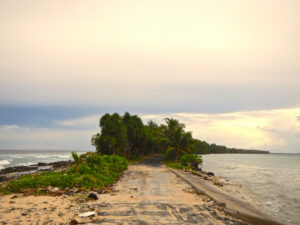
Climate change puts the edge between land and sea in sharp relief; sea level rise is essentially a condition of drifting littoral edges.As rising seas threaten to encroach on land-based territories, cities and nations have responded by attempting to fix the edge at a moment in time, blocking the sea’s insidious creep. Atolls formed by coral reefs are mobile, living geographies, which resist attempts to harden their perimeter through structures such as seawalls. We explore how ideas and imaginaries associated with the “edge” between sea and land in the atoll-nation of Tuvalu illustrate competing “riskscapes” and objectives associated with the actors involved. This essay explores this interplay between politics, aid, technocratic solutions, media representations, global aspirations, local ambitions, and climate risk in Tuvalu through an examination of past/future seawalls and other proposals (realized and unrealized) for controlling atoll edges. Through the cases, we seek to re-politicize the edge, unpacking the difficulties surrounding adaptation issues in small-island states, and explore alternative models of “resilient edges” for atoll-dwellers living with climate changes.
Article
Open Access
Cidade Oceanico. Environment and Urbanization in Rio de Janeiro
by José Gámez, Jeffrey S. Nesbit
pp. 439–459
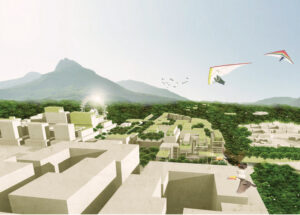
Using Rio de Janeiro as a case study in urbanization within the context of climate change, this multi-year urban design studio examines the challenges of addressing rising sea levels in one of Latin America’s largest cities. As a coastal metropolis, Rio requires that heterogeneous networks be woven between ecological and 21st century urban design processes. Yet, Rio continues to grow in low-lying, ecologically sensitive areas - and this has been exacerbated over recent decades by mega-event driven development coupled with inter-dependent informal urbanization. These forces characterize Zona Oeste, the focus area of the design initiative. This essay reflects on an international urban design pedagogy that seeks to integrate strategies to address climate change, rising sea levels, and unpredictable growth. Inherently, this project opens up a discussion into many sensitive questions regarding historical and cultural responsiveness. Filtered through the work of Lucio Costa, his proposals for Baja da Tijuca, and opportunities to re-engage the legacy of a modernist plan, students engage this rich context through a discursive design prompt with implications for both pedagogy and practice within and beyond Rio de Janeiro.
Article
Open Access
Miami Rising: Historical Perspectives on Sea Level Rise as a View into the Future
by Eric Firley, Victor Deupi
pp. 367–387
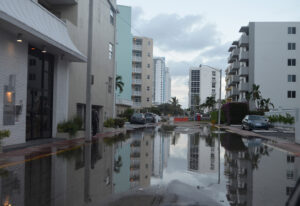
Miami is a city whose diversity and vibrant growth has made it an ideal destination for international travel, business, and leisure. However, South Florida is a hurricane prone region, and the threat of sea level rise and erosion poses an immediate and long-term risk to the stability of the city and its region. The city and the scientific community have been studying the phenomenon for some time now, proposing solutions to the management of such threatening uncertainty. Yet the quest for coastal resilience is not a new phenomenon. Since ancient times human settlements have entertained a complex relationship to the water. This paper will explore how several cities throughout history have dealt with flood resilience challenges and consider how historical attempts to adapt and address such problems can provide new spatial strategies for Miami’s future. Aware of the fact that such a study cannot reveal technical solutions for the twenty-first century, the emphasis will be given to an understanding of the correlation between socio-economic identity, attitude towards defensive action, and the type of organization needed for concerted action.
Article
Open Access
Groundedness as Risk: Adaptive Strategies for Ground Failures in Seattle
by Arthur Tai-Ming Leung
pp. 295–317
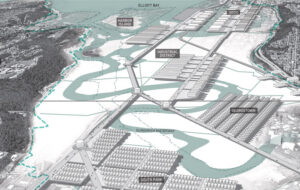
“Groundedness” implies stability and permanence, but our reliance on the presumed fixity of the earth under our feet has led us to lose sight of its dynamism. From macro tectonic readjustments to micro sediment transport, these natural processes are part of an adaptive cycle that oscillates between stasis and destruction. Urban development, predisposed to Engineering Resilience, has exacerbated disasters by attempting to fix and control ground without considering the recombinant and indeterminate systems of Ecosystem Resilience. Seattle is the largest city in a region due for its “Next Big One” - a megathrust earthquake in the Cascadia Subduction Zone. This high-magnitude perturbation would occur in an urban context already sensitive to geologic risks. A history of land manipulations has affected Seattle’s ground equilibrium, making it more susceptible to natural disasters. The urgency of the impending risks has inspired adaptive design that foregrounds action as a means of developing a disposition. A catalogue of strategies is applied to a masterplan that balances “sediment” as a resource that builds resilience to ground hazards and promotes ecosystem health.