
Archive
Tipo contenuto: Article
Article
Subscribers
Collective Creativity in a Geodesign World: The DC-Baltimore Futures Studio
by Jana VanderGoot, Dan Engelberg, Gerrit-Jan Knaap
pp. 377–400
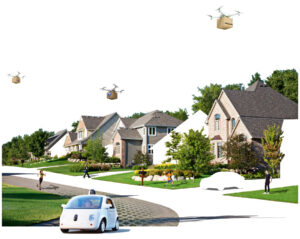
In the spring of 2018, the National Center for Smart Growth (NCSG) invited architects at the University of Maryland to engage a project called PRESTO (Prospects for Regional Sustainability Tomorrow). PRESTO is believed to be the first attempt at addressing the long-term sustainability of the DC-Baltimore region using advanced algorithmic modeling and scenario analysis techniques to examine the impacts of fuel costs, technological advancement, and government regulation. This article highlights contributions of the DC-Baltimore Futures: Designing XL to XS studio as it engaged the multi-disciplinary NCGS team on PRESTO, which is described in this article as a geodesign project. The impact of collective creativity as part of DC-Baltimore Futures studio pedagogy is discussed as one of the many ways that the PRESTO algorithms were tested. The article concludes with reflections on the role and potential of collective creativity in open source modes of geodesign and “senseable” city design.
Buy
Already in your cart -
View cart
Article
Subscribers
The Engaged Project: Representation, Dissent, and the Architecture of Public Space
by Jennifer Akerman
pp. 341–362
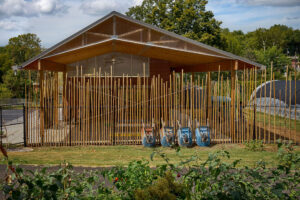
Vandalism is an alternative form of design narrative, a subversive practice of reading architecture and urban systems, and a fundamental way key voices can be heard. Architects, city planners, officials and the public should value such reads as constructive engagement enriching the life of a built work. Architecture usually results from elaborate systems of power, capital, and privilege - though its presence affects everyone in the city. In the periphery of public space, dynamic alternative practices emerge that communicate and critique. Vandalism, especially in areas of contested “ownership” in public space, is an architectural counterpoint, a dissent available to people without conventional means of power. It is intrinsically linked to the pedestrian experience of cities, and therefore opens reconsideration of walking as knowing, especially in an urban terrain vague [empty lot]. Technologies of sharing allow us to broadcast transgressions, track goings on, exploit urban problems for artistic gain, and conduct vandalism in public space. Focusing attention on a public farm building designed collaboratively within an urban park will frame broader discussion of these complex relationships at work, specifically considering vandalism as a form of engagement.
Buy
Already in your cart -
View cart
Article
Subscribers
Crowdsourcing + Shared Architecture
by Niloufar Vakil, Joe Colistra
pp. 363–373
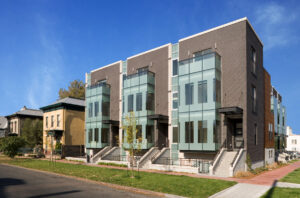
This paper describes a participatory development strategy that leverages the cooperative nature of a sharing economy. Three case studies will be explored that provide unique strategies for empowering community. These crowdsourced projects pool resources and expertise in order to design and build projects that resist gentrification, stimulate investment, and build community. Residents utilize the participatory actions of establishing a pro forma, acquiring land, securing financing, selecting professional engineers and contractors, and ultimately constructing the project all as larger components of community building. The models of community development presented here offer an alternative to the traditional designer-client dichotomy and allow the once-clear boundary between architect and client to be redrawn. Also, by sharing resources, community members are able to become active participants in their built environment.
Buy
Already in your cart -
View cart
Article
Subscribers
Towards a Cooperative Architecture Platform
by Jose Manuel Sanchez
pp. 327–340
This paper outlines the use of videogame simulations as a representation of the complex interactions of resources within an urban neighborhood. The research advances the use of videogames as a mechanism for the production of design patterns for the city, in the hands of its inhabitants. By establishing a real-time feedback loop between players and an ecological simulation of the city, a user can learn and make decisions that could be shared with a community. This paper will mainly discuss the research developed through the videogame Block’hood, a project developed by the Author at the University of Southern California School of Architecture and the Plethora-Project research that attempts to critically address the use of mass media technology for collective organization and value production.
Buy
Already in your cart -
View cart
Article
Subscribers
Using Digital Data for Office Design. “The Case Study of the Agnelli Foundation”
by Carlo Ratti, with Antonio Atripaldi, Melanie Erspamer, Daniele Belleri
pp. 315–325
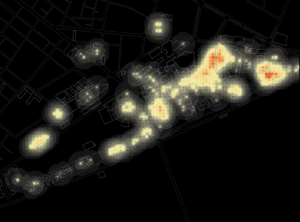
In the nineties, it was widely assumed that, because of the internet and widespread connectivity, the importance of physical space would be greatly reduced. Many prophecies at the time dealt with the “death” of distance, of cities and of offices, among others. While such predictions have not materialized so far, technology is nonetheless having an effect on how we use physical space. In particular, office spaces are undergoing a profound transformation. In this article, we review a recent project from Massachusetts Institute of Technology’s (MIT) Senseable City Lab, which used the analysis of digital data to better understand the use of office space and scientific collaboration on the MIT campus. We then show how some of these preliminary findings can be used in the design of the co-working space at the Agnelli Foundation in Turin, Italy - and how digital data can then provide real-time monitoring of built spaces.
Buy
Already in your cart -
View cart
Article
Digital Technology
Subscribers
An Ontology of Robotic Architecture
by Mahesh Daas, Andrew John Wit
pp. 127–139
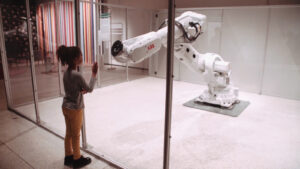
Robotics has recently found themselves more engrained within the ethos of architectural research and production. However, their relationship to architecture still remains to be understood. This article examines the relationship between robotics and architecture from an ontological standpoint. The article offers foundational frameworks and raises key questions to broadly define robotics in architecture.
Buy
Already in your cart -
View cart
Article
Landscape Urbanism
Open Access
Cities as Hydro-Geologic Terrain: Design Research to Transform Urban Surfaces
by Mary Pat McGuire
pp. 165–190
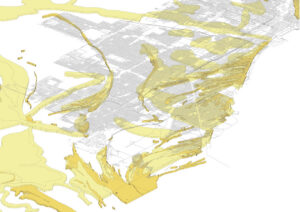
Imperviousness is a significant design problem for the future of cities: we must reduce it, redesign it, transform it. This paper argues to insert hydro-terrain thinking to the paved surfaces of cities, instantiating the concept of “rain terrain” that links hydrologic performance across scales, from the raindrop to the region. The City of Chicago is the case study where high concentrations of pavement drain stormwater from the city - resulting in flooding, overflowing and polluting - from the Great Lakes to the Gulf of Mexico. I first share research on the glaciated history of the region, to reveal sandy soil types located in the urban area. I then correlate imperviousness, permeable soils and flooding prevalence to identify a pattern of site opportunity areas in the city. I also propose design practices - through disruptions, interventions and reconfigurations of urban surface - to tap paved-over soils as the basis for a landscape-based urban stormwater approach. In doing so, this paper aims to present a vision for urban transformation, based on specific technical design opportunities within landscape-as-infrastructure.
Article
Open Access
Climate Change Adaptations for Coastal Farms: Bridging Science and Mātauranga Māori with Art and Design
by Martin Bryant, Penny Allan, Huhana Smith
pp. 497–518
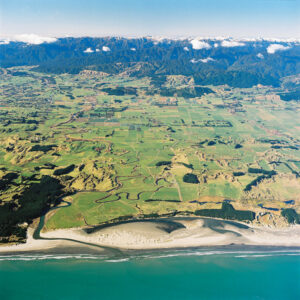
Indigenous coastal farming communities need to address future climate change impacts, yet many communities are slow to respond, due to lack of adequate information, economic pressures, the abstract nature of climate change science and poor communication between what science knows and what indigenous farming communities need to know. Art and design can address these issues by synthesizing broad scientific principles with local place-specific culture and their visual language can effectively communicate short and long-term benefits to local communities. Art and design are thus both generative research methods and media for representation. This research uses art and design to provide a bridge between the Māori culture of a local farming community in coastal New Zealand and climate change science. It provides a framework of strategies for new farm practices. Underpinned by the qualitative awareness of thresholds and an open-ended toolbox of land-based strategies, the role of the framework is to catalyze adaptation. The framework is responsive to both the Māori worldview and scientific knowledge, and has the potential to provide a model for other coastal communities.
Article
Open Access
Challenges of Disaster Relief Housing: Evaluating Coastal Domestic Typologies in Eastern Sri Lanka
by Kira Bre Clingen, Mark Robert Bavoso
pp. 601–628
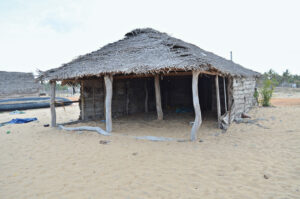
In the aftermath of the December 2004 tsunami, an unprecedented natural disaster that disproportionately affected the impoverished and conflict-ridden eastern coast of Sri Lanka, the outpouring of disaster relief and support for housing reconstruction was primarily led by international aid organizations for the erection of capital-intensive dwellings to allow for immediate habitation. Three case studies representative of significant housing typologies deployed since the tsunami are investigated: two global prototypes sponsored by foreign aid, and one informal, vernacular construction. We argue that in Sri Lanka the aid-housing-as-commodity paradigm - which in its specificity and immutability disregards the robust tradition of integration between natural and built environments and between individual and community - represents an increasingly and unsustainably risky expenditure of capital resources due to the likelihood of more frequent disasters in coastal zones. We argue for a shift toward spatial frameworks, not static prototypes, which take into account that the longer temporal dimension of rebuilding community and housing after a natural disaster is not necessarily synonymous with expensive, structurally robust building practice.
Article
Open Access
Mangroves of Maputo, Mozambique: from Threatened to Thriving?
by Ana Beja da Costa, Luis Paulo Faria Ribeiro
pp. 629–641
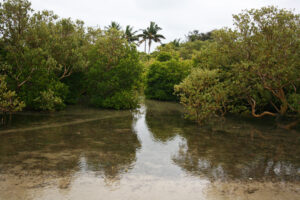
Coastal wetlands worldwide are among the most productive yet highly threatened systems in the world, and are framed and protected by the Convention on Wetlands (Ramsar, Iran, 1971), of which Mozambique is a party since 2004 (IUCN, 1971). Maputo city coastline consists of an ample alluvial plane, where large extensions of mangrove forests occur within the city, namely the Costa do Sol wetlands, offering a wide range of ecological and economical services. Here, urban development pressure is increasing and rapidly changing dynamics are creating new urban settings, pressing in ecological sensitive areas of Maputo’s coastline. The functions of the still existing ecosystems and positive effects that these can have within the urban environment are relevant to be known and investigated in light of the greenway principles. Through the landscape architecture lens, insights on the service capacity of these mangroves in terms of conservation strategies, local perception, usage and management, and design possibilities are added, which can contribute to maintain and expand the high urban quality that is historically attached to Maputo city.