
Archive
Tipo contenuto: Essay

Essay
Subscribers
Navigating AI-Enabled Modalities of Representation and Materialization in Architecture: Visual Tropes, Verbal Biases, and Geo-Specificity
by Asma Mehan, Sina Mostafavi
pp. 267–282
This research delves into the potential of implementing artificial intelligence in architecture. It specifically provides a critical assessment of AI-enabled workflows, encompassing creative ideation, representation, materiality, and critical thinking, facilitated by prompt-based generative processes. In this context, the paper provides an examination of the concept of hybrid human–machine intelligence. In an era characterized by pervasive data bias and engineered injustices, the concept of hybrid intelligence emerges as a critical tool, enabling the transcendence of preconceived stereotypes, clichés, and linguistic prejudices. This paper not only explores the applied and generative capacities of AI-enabled workflows but also suggests fundamental approaches that can enhance the creative process and confront the embedded biases and injustices within data-driven systems.
Buy
Already in your cart -
View cart

Essay
Subscribers
To Think a New Thing: AI, Metaphor, and the Fantasies of Knowing
by Karel Klein
pp. 303–315
This essay aims to explore the unexpected intersection of AI-generated images, metaphor, and fantasies of knowledge. Expanding on the notions of metaphor in the philosophy of Jose Ortega y Gasset, we view the AI-generated images (such as those from mis-trained StyleGAN models) as ‘objects’ in possession of an inherent surplus that transcends their perceived qualities and constituent parts. Metaphors reveal latent qualities of ‘objects’ that extend beyond human perception. We consider how these image-objects operate not merely as generators of visual metaphors but as metaphor-like entities themselves, shifting our perception of reality. As a result, these image-objects behave like disembodied expressions of a new kind of knowledge. This feeling, or fantasy of knowledge, is what Steven Connor calls ‘epistemopathy.’ By examining the interplay between human imagination, AI-generated outputs, and the epistemopathic experiences they evoke, we explore how AI becomes a manifestation of the human desire for expanded knowledge and imaginative exploration. In the blurring of the boundaries between our own understanding and AI’s perplexing output, we are confronted with a sort of knowledge boundary that conflates reverie with reasoning.
Buy
Already in your cart -
View cart
Essay
Subscribers
AI and Design Synthesis: Hybridity and Hybrid Form
by Karim W. F. Youssef
pp. 335–348
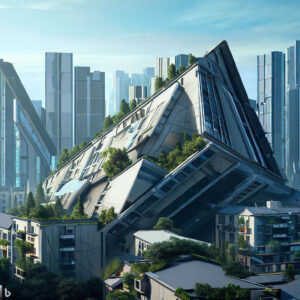
AI, as a gamechanger, is revolutionizing the architectural and urban scenes so drastically that the way our buildings and cities will look like and be experienced will fundamentally change. The overarching purpose of the paper is to take a modest step towards understanding the paradigmatic role of AI in changing the form of our built environments. The paper conceptualizes AI’s role in the design process as essentially the suggestion of hybrid solutions, transforming the nature of the built environment to a hybrid between its static and non-static, real and virtual forms. The basic question to pose is the role of AI technology in assisting the design process, gearing it towards the creation of hybrid forms that redefine the relationship between humans and their built environment in a meaningful way and that also address the complex problems of our contemporary society which hinge upon the resilience of the architecture and urban form of the space we inhabit. AI technology is being increasingly embedded into our inhabited environment affecting the built expression of architecture as well as the process and practice of designing architecture.
Buy
Already in your cart -
View cart
Essay
Subscribers
Site and AI: A Paradigm Shift
by Genevieve Baudoin, Bruce A. Johnson
pp. 319–333
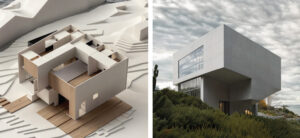
AI’s potential is in its ability to sift through vast amounts of contextual data that can drive design decisions. It offers the opportunity to process information about a virtually limitless number of subjects, at a conscious or unconscious level. This has created what Thom Mayne describes as a “paradigm shift” in our perception of site. The architect can now curate, directing results based on AI to restore specificity to projects that, through the distance created between the real site and the computer model, we have lost along the way. We rely on technological workarounds to fix many designable issues in our buildings – an over-reliance on climate control, a willingness to place buildings directly in harm’s way (i.e., building on flood plains), and an ignorance of the context of a site (from archeology to gentrification). This paper offers a provocation: AI can create a return to site and construction sensibilities by harnessing layered data sets such as orientation, topography, climate, or even social fabric. Can AI chart a course towards less reliance on technological band-aids in the production of building?
Buy
Already in your cart -
View cart
Essay
Open Access
Jarvis, Hal, or AlphaZero? Looking Beyond Conventional Narratives Concerning AI and Architecture
by Cem S. Kayatekin, June Aoun, Yusuf Sühan Bozkurt, Daphné Fournel
pp. 217–236
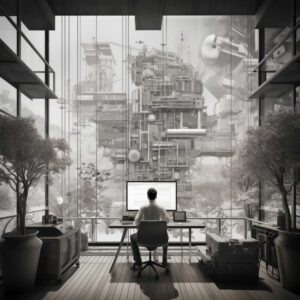
Since early 2021, the discourse concerning the potential and impacts of artificial intelligence on architecture has radically expanded. Discussions have largely focused on the heightened levels of productivity or efficiency that can be achieved within the existing ecology of architectural production processes, as well as the potential disruptions that may arise through human–AI co-authorship of the built world. What this paper asserts is that these dominant narratives appear to be extensions of quite conventional storylines which either frame artificial intelligence as a hyper-computational prosthetic for the enhancement of the architect or architectural office or as a critically disruptive force that will trigger micro- to macro-scale reconfigurations of the domain of built- environmental authorship. The dilemma is that we appear to be thinking of AI on old models of brute-force computation (i.e., Deep Blue) or dystopian conceptions of AI systems that can readily cross-pollinate with and radically disrupt existing societal configurations and dynamics (i.e., HAL-9000). What we have not quite considered are the real capacities and limits exhibited by artificial neural networks anchored around self-play reinforcement learning models (i.e., AlphaZero).
Essay
Theory
Subscribers
In Search of the New Eden. From Le Corbusier’s Boîte to Sejima’s Curtain
by Javier Pérez-Herreras
pp. 115–132
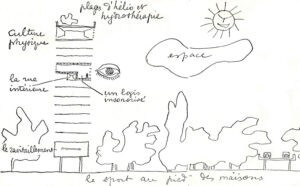
Le Corbusier’s Unité d’Habitation in Marseille established the relationship between an old man and a new world that arrived. This old self found in the interior of a long rectangle a domestic Eden that was once lost. The exterior was still a place for waiting, a place to be seen, writes Beatriz Colomina. But this modern Eden could not last forever: his indoor paradise had to move. In 1999 Terence Riley inaugurated at the Museum of Modern Art of New York the Un-private House. In it, he discovers a new dweller that does not occupy the interior of that domestic laboratory, but its own limits. Contemporary man is a social being, Jose Pardo asserts. His public self is moved to a liminal threshold, writes Victor Turner, that Kazuyo Sejima turns into the new house. Architecture is no longer the air volume contained within its limits, but that which prowls said limits. The new domestic home of contemporaneity becomes a porosity line: a curtain that publicizes domestic life. The house is converted into a habitat of borders, where man discovers his new domestic Eden.
Buy
Already in your cart -
View cart
Essay
Subscribers
At Home with the Collective: Hilberseimer, Labor Unions, and the Women’s Movement
by Alexander Eisenschmidt
pp. 299–323
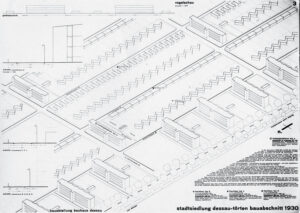
While housing could be described as one of the basic forms of architecture and one of its main responsibilities, if not today’s most crucial task, architecture has largely ceased to rethink established forms of living and the politics and economies that surround it. Escaping the pervasive models of profit-based home ownership in the West seems increasingly difficult when housing is dominated by neoliberal market values. Already at the beginning of the twentieth century, however, some architects struggled with similar conditions within the metropolis. Ludwig Hilberseimer’s proposals for new types of living for a new kind of liberated individual are particularly instructive today as they rethought housing as a right, allied with unions in order to rethink its financial models, and learned from activists in the Women’s Movement to question the dominant narratives around heteronormative family structures and domestic labor. In our time of ballooning housing costs, stagnant wages, failed trickle-down economics, and shortages of affordable housing, these urgencies have not lost but only gained momentum.
Buy
Already in your cart -
View cart
Essay
Subscribers
The Right to Housing: Architectural Composition as a Solution
by Claudio Meninno
pp. 325–343
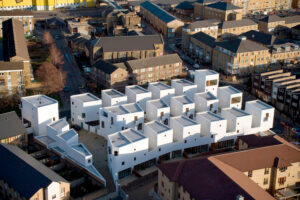
Housing is one of the main themes related to the creation of the city and plays a central role in the definition about how people live together. The development of new living strategies face many different fields of interest: urban planning, economy, social sciences, ecology, sustainability, technology. Architectural composition plays a central role in the definition of how all these matters can coexist and how it is possible to increase urban density and people’s quality of life. The analysis of Louis Sauer’s work on low-rise high-density houses outlines a solution useful for a variety of situations. Higher urban density makes it possible to increase real estate income from investments and, consequently, to increase the architectural quality of the buildings as well as the urban landscape. It gives a tangible answer to many aspects related to urban sustainability making the city more compact, reusing brownfields instead of greenfields, facilitating pedestrian cycle mobility or the use of public transport instead of private cars, and thus helping to reduce urban pollution and the use of natural resources.
Buy
Already in your cart -
View cart
Essay
Theory
Open Access
The Wall That Articulates: Characteristics and Operability in Space
by Joana Pinheiro
pp. 87–105
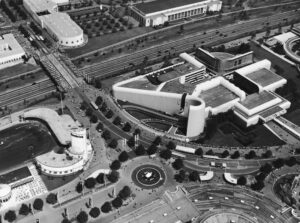
This essay stems from a dissertation that studies the “architectural wall” from a conceptual point of view. The wall acts in space in different ways and can present the purpose of emplacement, reference, articulation, enclosure or of an inhabitable wall. Among the wall types studied in the thesis, the wall that performs as an articulation agent is described in this paper. For that matter, a group of architectural works, that translate in a definite manner the operativity of this theory, is presented. Through the analysis of these case-studies, the definition of the type, by its determining properties, is reached. Besides considering this research as a scientific instrument in the field of architecture to understand the comprehensive element “wall,” which further interacts with man and its environment, it is also regarded as a didactical means. Through the acknowledgement of the properties given in the tables and diagrams of the type, it is possible along the process of design to identify this architectural element within its complex play of variables, and thereby use it in a more scrupulous and consequent manner.
Essay
Theory
Subscribers
The Transparency Trilemma: Interrogating Transparency in Architectural Design
by Matyas Gutai, Simon Richards, Aris Kafantaris
pp. 57–86
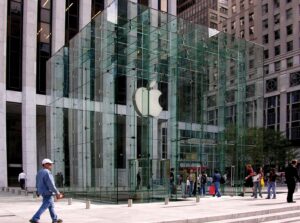
In light of emerging dialogues on the negative environmental impact of glass buildings that culminated in the glass building ban proposal in New York City, this paper reinterrogates the meaning and potentials of transparency in architecture. This is done by introducing the concept of the “Transparency Trilemma,” whereby glass envelopes are believed to be unable to provide thermal comfort, environmental sustainability, and optical transparency at the same time. By re-evaluating transparency from technical, spatial, and semantic viewpoints, this paper presents a comprehensive new Transparency Framework for the overall assessment of buildings on these grounds. The use of this framework can facilitate a more holistic evaluation of glass buildings across the full range of their potential meanings and applications, which would support better design and understanding of the role of transparency in contemporary architecture.
Buy
Already in your cart -
View cart