
Archive
Tipo contenuto: Essay
Essay
Theory
Subscribers
Urban Autophagy. A New Imaginary for Twenty-First Century Urban Growth
by Hannibal Newsom
pp. 37–55
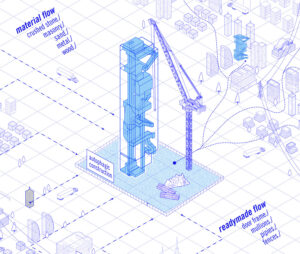
The human, environmental, and political impact of raw material resourcing throughout the global supply chain is a critical facet of any plan to confront accelerating climate change in the twenty-first century. Invoking the work of biologist Dr. Rhonda Patrick on autophagy, a mechanism through which mammalian bodies consume their own dead and dying cells to promote health and longevity, this essay explores the imaginary of Urban Autophagy as a mechanism through which the city can consume itself in order to grow. This essay presents a novel understanding of the limits of our natural resources and proposes a major shift in how we conceive of standard practices for sustainable development. First, this essay defines the model of Urban Autophagy; second, it surveys already-existing practices that support the model of Urban Autophagy; third, it presents a methodology that can be developed and expanded in order to introduce Urban Autophagy into standard practice; and finally, this essay argues for the implications of this approach toward a more ambitious stewardship of the environment and the health and longevity of our cities.
Buy
Already in your cart -
View cart
Essay
Criticism
Subscribers
Japanese Architecture Returns to Nature: Sou Fujimoto in Context
by Botond Bognar
pp. 7–36
We received and we gladly publish a contribution by distinguished author Prof. Botond Bognar. [MS]
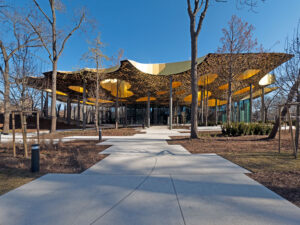
ABSTRACT - The essay introduces the development of Sou Fujimoto’s architecture as it has been influenced by various sources and experiences leading to his recently completed and highly recognized major project, the House of Hungarian Music in Budapest. Among these influences the contemporary economic and political conditions in Japan and beyond, as well as the nature-inspired work of prominent Japanese designers are discussed. Touching upon the seminal work by Tadao Ando and Toyo Ito, the essay also highlights the contrasts and occasional similarities between the so-called “White School” and “Red School” in contemporary Japanese architecture, in referencing nature as the primary source of their designs. Today, these “schools” are best represented, respectively, by the activities of SANAA and Kengo Kuma. Although Fujimoto’s architecture is clearly derivative and part of the radically minimalist White School, the House of Hungarian Music reveals an intimacy and richness in articulating its relationship to the surrounding natural environment, which quality, if perhaps momentarily, points beyond the minimalism of the “Whites.”
Buy
Already in your cart -
View cart
Essay
Subscribers
Re-Emergence of the Vernacular: The Material Aspirations and the Vanishing Continuum of the Immaterial
by Chaitra Sharad, Sanket Mhatre
pp. 361–378
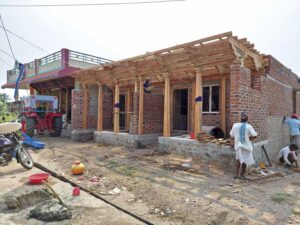
The cultural elements drive the people’s way of life and ultimately influence their choice of the buildings they inhabit. Man, and his culture and his living environments are always correlated. While measuring heritage architecture, one tends to ignore the cultural and societal factors as the stakeholders. This isolated study can often paint half a picture of what a place was or could have been. An in-depth understanding of the “human element” will help appreciate the true “spirit of the place” despite the style, geometry, material, or construction method. While looking at a piece of craft, present-day perception focuses only on certain limited qualities such as visual or construction. Instant benefit has led to mass use of fabricated materials while ignoring any cautionary examination. Definition of any material’s sensual, social and symbolic worth often remains out of the scope for judgment. If these values are prioritized well, the architecture can continue to progress as a modest expression, adding a personality or realizing a life rather than producing alienating objects.
Buy
Already in your cart -
View cart
Essay
Open Access
2 in 1 – A Playful Approach to the Sustainable Use of Building Materials
by Angie Müller-Puch, Erik Hegre, Michael Innerarity
pp. 323–336
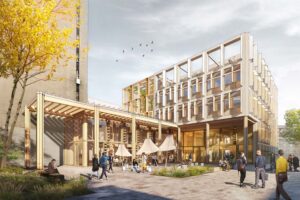
To the observer, the building industry strives to develop the most optimized construction materials to build faster, better and cheaper, which has created an expanding pallet of increasingly complex, highly specific product systems. As a result, it is assumed that buildings are comprised of an established collection of parts, selected from a catalogue, and have the consequence of a one-time useful lifespan. This does not suggest that we have abandoned technological development; however, we suspect this approach will stall in its ability to address environmental challenges and create healthy, quality spaces because the sum is not greater than its parts. What if we use and assemble materials in a way that they can serve multiple functions at one time? The 2 in 1 – design strategy is a playful process that assembles materials so one material can incorporate several functions at a time. By finding synergies between well-known, standardized construction elements we can create a positive effect on the quality of building and reduce the carbon footprint.
Essay
Subscribers
Reading (Hidden) Dialogue of Organic Tectonics
by Resza Riskiyanto, Yandi Andri Yatmo, Paramita Atmodiwirjo
pp. 415–435
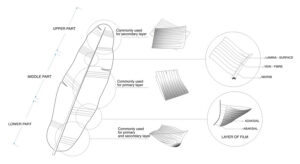
This article explores the potential of organic material to conceptualize new means of future tectonic beyond the duality of construction technology and representation through a case study of indigenous craft making. Particularly, we propose the understanding of organic tectonic practice as the dynamic action among the human body, spaces, surface, materials, structural systems, and construction. This idea is demonstrated through the tectonic exploration of banana leaves wrapping practices. The practice has been culturally established as a common indigenous technique in Indonesia, and it has been transmitted across generations through the direct practical demonstration of “making.” The findings suggest that the essence of tectonic practice may be found not merely through its materiality but also within the dialogues that occurred during wrapping operation as an integrated set of action knowledge. The exploration of banana leaf wrapping typologies introduced the idea of tectonics as a whole process that considers the relationship between elements that are often separated. This study concludes that the knowledge of action is equally essential with material properties. Such knowledge must be maintained and promoted as a possibility of searching for good materials in contemporary design practices.
Buy
Already in your cart -
View cart
Essay
Subscribers
Open-Air-Space: Inclusive Involvement within a Public Health Crisis
by Ulysses Sean Vance
pp. 365–384
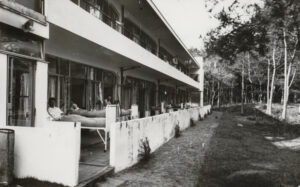
Since the eighteenth century, the healing arts have included open-air treatments, with the field hospital at the Royal Sea Bathing Infirmary near London being one of the earliest medical care facilities on record to successfully treat patients in this manner. Florence Nightingale began applying the principles of open-air treatment to architecture when she proposed an open-ward hospital design as a means to provide pure air to the sick. Her perspective would directly influence nineteenth- and early twentieth-century hospital design, which increasingly had to address the rising incidence of infectious diseases in cities. However, hospital design in the twentieth century began to rely on mechanically conditioned air rather than open-air spaces to provide filtered ventilation and reduce particulate contamination. In the twenty-first century, even as the world faces the public health crisis of the global COVID-19 pandemic, the Open-Air-Space Project conceptually revisits the open-air spaces of hospitals. The project basis is the “open plan,” whose structural origin is in part the Maison Dom-Ino system by Le Corbusier.
Buy
Already in your cart -
View cart
Essay
Open Access
Imprints of an Invisible Virus: How Airborne Diseases Change Cities
by Aki Ishida
pp. 311–330
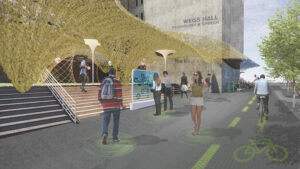
Once a clinical cure for COVID-19 is found, which infection prevention practices – both social and spatial – might remain, and what long-term impacts will they leave? This article examines the interrelationships between airborne diseases, social practices, and the design of physical and digital infrastructures for cities. Historically, infectious diseases have left long-term imprints on cities, from plumbing to hospitals. Spatial practices to prevent infection, such as clear physical barriers and car-free streets for socializing, must be implemented with a close examination of impacts on the mental, social wellbeing of both individuals and the broader community. Prevention practices examined include the use of transparent barriers that separate and connect people, the increased use of open windows, the adaptation of sidewalks and roads for physically distant socializing, and spatial negotiation and trust-building that occur in public spaces. As cities make design and policy changes to protect their citizens from the invisible virus, they must be mindful of the imprints the physical, social, and policy changes have on comprehensive wellness and equity for all people.
Essay
Criticism
Subscribers
We are All Counterinsurgents Now
by Britt Eversole
pp. 53–70
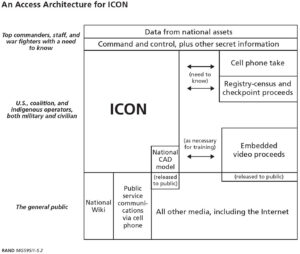
The increasing production of robust, information-laden, parametric architectural and urban models has outpaced a critical evaluation of the ethics of contemporary modeling and visualization practices which, rather than reflecting reality, are transforming it. This essay exposes the logics of the expropriation of architectural and urban models in a decade-old RAND Corporation endeavor to envision a comprehensive digital counterinsurgency strategy. To encourage professional and cultural agents, as well as unwitting civilian agents, to populate databases with urban and environmental data, RAND proposed weaponizing open-source, big-data urban models and participatory platforms to create multicultural, user-friendly interfaces. Conceived to appear like an exercise in open-source digital democracy and participatory knowledge-sharing that would spark emotive responses such as pride and fear, RAND focused on the cognitive and affective side of digital participation and information sharing to wage a counterinsurgency in the minds of civilians and insurgents. When the models that architects build can be weaponized to ends other than realizing buildings and cities, when they become instruments for influencing behavior and facilitating warfare, there is an urgent need for an ethics of visualization.
Buy
Already in your cart -
View cart
Essay
Theory
Open Access
Musings on Boredom, Midcentury Architecture, and Public Spaces
by Andreea Mihalache
pp. 119–138
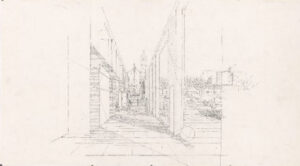
The rejection of “boredom” fueled the midcentury reaction against modernism, but little is known about the complicated presence of this mood in the architectural discourse. Far from being a mere rhetorical tool, the quip “Less is a bore” is part of Robert Venturi’s larger interest in boredom and was influenced by his reading of a book referenced repeatedly in Complexity and Contradiction in Architecture (1966): August Heckscher’s The Public Happiness (1962). A liberal writer and political activist, Heckscher situated boredom at the core of modern humanity’s alienation. While the concern with boredom was explicitly addressed in the humanities, I suggest that it was taking shape in midcentury architectural polemics under the influence of writings from other disciplines, as well as the emerging artistic practices that were deliberately embracing the “aesthetics of boredom.” Specifically, I will examine Venturi’s reading of Heckscher through two of his (unbuilt) civic projects that directly engage the issue of boredom: Three Buildings for a Town in Ohio (1965) and the entry for the Copley Square Competition (1966).
Essay
Theory
Open Access
On the CIAM 7 Grid: From an Ideological to a Critical Tool
by Pierre-Alain Croset, Andrea Canclini
pp. 89–117
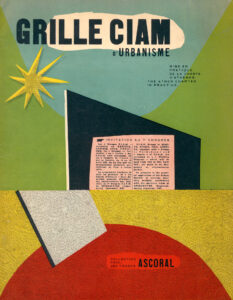
Much historiographical research has been produced on the post-war CIAMs, demonstrating the importance of the CIAM Grid, proposed as a “thinking tool” for representing the town planning projects at the CIAM 7 in Bergamo (1949). This essay proposes a new critical and epistemological examination of the CIAM Grid based on new archival documents and on a rereading of the exact words used by Le Corbusier, who proposed to consider the Grid as an “interlocutor.” Seventy years later, we propose to go beyond the failure of CIAM 7 and to elaborate a “new Grid,” with the name of “Second Life Grid,” as a critical tool for discussing exclusively projects related to the new paradigm of recycling and reusing buildings and urban spaces. Beginning with the question of the critical legacy of the CIAM Grid, our intention was to think of a Grid conceived no longer as an instrument of dogmatic and normative thought, but as an instrument of dialogical criticism which has been tested through an open call for projects and an international conference held in Bergamo in October, 2019.