
Archive
Tipo contenuto: Essay

Essay
Cross-Disciplinary Studies
Subscribers
Wellbeing in the Built Environment: Designing Discontinuities Between Function and Semantic
by Nicoletta Brancaccio, Davide Giacomo Maria Gattoni, Federico Niola, Stefano Rozzi
pp. 31–52
Space is relational. How many relationships can occupy a space? How do they work? These are both interesting questions that we would like to answer. We know that we interact with space and that its configuration affects us: we can be aggregative while experiencing it, rather than competitive. Space has considerable power in influencing our brain. Essentially, our actions are somehow manipulated by what we see and what we touch. How does our space (peripersonal space) interfere with another’s? The idea of interaction within space (or social space) and space of selfhood thus becomes an essential subject for architecture and cannot be simply parameterized in a geometric manner. Physical space must, therefore, allow solitary or cooperative movement without alienating the individual. We base our judgments on movement, culture, personal psychical characteristics, memory, and personal experience. Taking these elements as our base, we gave a new perspective for designers to draw from the semantic, which can be rhetorical and disconnected by the function.
Buy
Already in your cart -
View cart

Essay
Theory
Open Access
American Mirror: the Occupation of the ‘New World’ and the Rise of Architecture as We Know It
by Fernando Luiz Lara
pp. 71–88
This paper argues that the rise of architecture as a unique discipline and the conquest of the American continent are not just chronological coincidences but interdependent variables of the same process of modernization. Traditional scholarship in architecture has not entertained those parallel developments at all. The field of architectural history and theory still treats the spatial occupation of the Americas as a consequence of the Renaissance and European modernization, despite a few decades of scholarly literature in related disciplines questioning such assumptions. (Fanon 1961; Said 1978; Dussel 1980; Bhabha 1987; Escobar 1994). Such scholarship demonstrates that the encounter of 1492 and the territorial occupation that followed played a central role in the development of Western culture in general, allowing the extrapolation of the same logic to the architectural discipline in particular.

Essay
Subscribers
Making Room and Occupying Space. Women Conquering and Designing Urban Spaces
by Chiara Belingardi, Claudia Mattogno
pp. 371–390
Women have always been strongly involved in creating environment and living spaces, even without initially being designers as the university became accessible to them very late. However, they were always strong involved in creating a healthy environment, and contributing to welfare state, where health and social equipment was a gender response to a modern life. Anyway, the history of architecture remains dominated by Masters and the female presence is almost invisible, even though women’s studies have made a large contribution to investigate lives, stories, and professional works. The paper highlights the contribution of women as builders of social and physical spaces from late nineteenth and focuses on Italian movements of second and third generation feminists. Nowadays feminists are pointing out invisibility of women as a structural violence, are claiming commons and creating new uses for urban space.
Buy
Already in your cart -
View cart
Essay
Subscribers
Women’s Work: Attributing Future Histories of the Digital in Architecture
by Shelby Doyle, Nick Senske
pp. 307–326
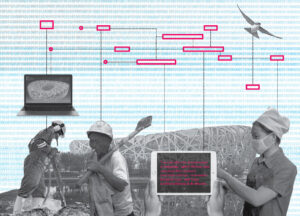
Conventions of authorship and attribution historically excluded or erased women’s contributions to the built environment. As frequent co-authors and collaborators, women’s stories often do not fit into conventional historical narratives about how architecture is created. In response, this essay proposes a technology called “attribution frameworks”: a digital method for creating a transparent record of architectural labor. The authors argue that the integration of digital tools into architectural design offers a new space for more equally attributing, documenting, and counting labor and contributions to the discipline. This space allows for a more rich and inclusive narrative of contributions to architectural production for the future.
Buy
Already in your cart -
View cart
Essay
Theory
Subscribers
Digital Line: Architecture’s Expanding Thread
by Johan Voordouw
pp. 47–65
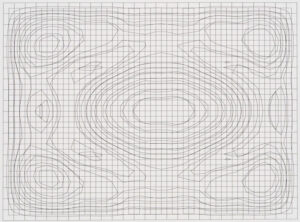
This article studies the changing role of line in architecture. The paper argues that digital production has led to a subsequent shift of lines as trace, towards lines as “spatialized” thread. This thread is moving away from orthographic and perspective modes of representation through three embedded modes of conception: the digital model, diagram and notation. These new lines have a long and alternative lineage in architectural ideation. The paper explains each mode in turn, indicating the importance of the model as a line in space embedded since the very inception of western architectural discourse; the edifying role of the diagram as a line of operation clarifying architectural ideas; and the new material ground that links notation to fabrication, and continued actualization in the pursuit of new architectural ideas. By expanding the line in architecture, the digital line better connects emerging representational modes to established architectural thinking and opens new ground to further representational discourse.
Buy
Already in your cart -
View cart
Essay
Urbanism
Subscribers
Reconfronting Sprawl: Still Paved with Good Intentions as Well as Asphalt
by Doug Kelbaugh
pp. 187–199
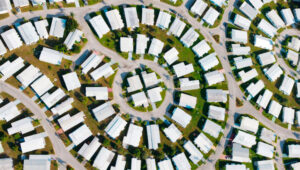
This paper, based on the author’s new book The Urban Fix: Resilient Cities in the War against Climate Change, Heat Islands and Overpopulation (2019), culminates over three decades of researching, teaching, and writing on American sprawl. One of the country’s biggest and most familiar problems, it could be described as a conspiracy of good intentions: short-sighted desires to live in nature; traffic safety engineers’ preference for wide thoroughfares; fire marshals’ desire to turn around hook-and-ladder trucks at the end of every cul-de-sac, etc. Over half of American homes are single-family dwellings – 69 million out of a total of 132 million. The fatal flaw is that these positive intentions quickly led to very high energy/carbon/ecological footprints per suburbanite – a challenge that is difficult because of extensive, indelible infrastructure. Densifying arterial strips, inserting transit, redeveloping a walkable, bikeable, mixed-use, and human-scaled urbanity is as urgent as it is essential in the nation’s effort to combat climate change.
Buy
Already in your cart -
View cart

Essay
Subscribers
The Future of Urban Living in the Sharing Economy
by Wendy Wei-Yue Fok
pp. 301–314
This is the continued research and development that derived from the original doctoral research “Whose Digital Property,” probing into the ramifications brought about by the new business model of the “sharing economy,” and the concerns raised behind the issues of access, ownership and distributed rights among policy, economy, design and architecture, of digital and physical property law research. The doctoral research was defended in 2017 at the Harvard University Graduate School of Design with the Harvard School of Law as a partnering department. The discussion developed in this essay tries to show how several examples and trends suggest architecture and architecture-related software programming will likely become even more collaborative in the future and will necessitate a more strategic, articulated and multi-pronged cooperation between designers, companies and users.
Buy
Already in your cart -
View cart
Essay
Subscribers
Fluid Urbanism: How Information Steered Architecture Might Reshape the Dynamics of Civic Dwelling
by Sharon Wohl, Reny Revariah
pp. 401–426
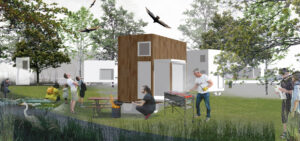
This paper speculates on how new forms of dwelling might be re-conceived as more nimble, flexible components: ones capable of deploying to different sites and atmospheres, while simultaneously providing more broadly distributed access to amenities that otherwise remain limited to the privileged few. Specifically, it examines the notion of a mobile dwelling architecture that could be deployed to various sites across the city - each site being characterized by particular “niche” offerings. Here, rather than dwelling units being considered as static entities within the urban fabric, they are re-considered as nimble, deployable agents - able to relocate to different sites and settings in accordance with different parameters that are customized through individual cost-benefit analyses and feedback dynamics. Accordingly, over time, bottom-up, self-organizing “niches” of fit inhabitation emerge. The paper associates this kind of designed environment with the dynamics of complex adaptive systems - where emergent global features arise from the bottom-up. Here, a kind of “swarm” urbanism is deployed: one adjusting over time in response to atmospheric variables.
Buy
Already in your cart -
View cart
Essay
Subscribers
Process of Commoning in the Production and Proliferation of Shared Space
by Olivia Hamilton
pp. 287–300
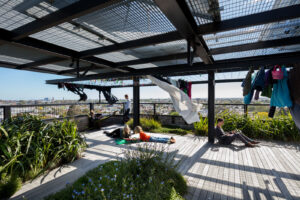
Commoning describes the social and psychological process that individuals and collectives are involved in as they establish and manage space and life shared in common. The values that underpin commoning can be adapted by spatial and urban designers to privilege and encourage more inclusive and shared social, civic and environmental conditions and disrupt existing models and economic forces that currently organise private and public space. Commoning produces spaces and social relations through participation, developing in the protagonists a sense of agency over their lives. Design practitioners with interests in the processes of commoning can engage with those values to interrupt the homogenization of communities and the cauterization of spatial imagination by commercial imperatives. Drawing on design precedents, theorists and activists involved with various aspects of contemporary commoning, this paper proposes how designers can be informed and guided by the interrelated spatial and social modes of productions that are integral to commoning. Through a commitment to commoning, spatial designers can encourage and support commoning and proliferate values capable of transforming the future.
Buy
Already in your cart -
View cart
Essay
Subscribers
The Sharing Cosmopolis. Prosperity without Growth
by Doug Kelbaugh
pp. 273–286
Why is sharing important to our civilization, our cities and the earth? It is critical, even essential to our survival, because without it, we will overconsume the planet’s resources and overheat it. It is of paramount importance that we find ways to increase prosperity without economic growth, or better yet, to achieve degrowth. Sharing our assets, our services and places, even our activities and experiences may be our best hope to reduce the human ecological, energy and carbon footprints. Whether a reformed version of capitalism or a fundamentally new economy, the sharing city and no-growth ethic form a large, profound and open question. In any case, from an energy use and emissions point of view, doubling energy and technological efficiency or doubling the intensity of asset use though sharing have much the same impact - whether it is cars, transit, homes, equipment, offices or workshops. This realization opens up a huge new opportunity for reforming or replacing neo-liberal capitalism with longer-term thinking and more humane economics.
Buy
Already in your cart -
View cart